Best Portable Power Stations for Car Camping (2026)
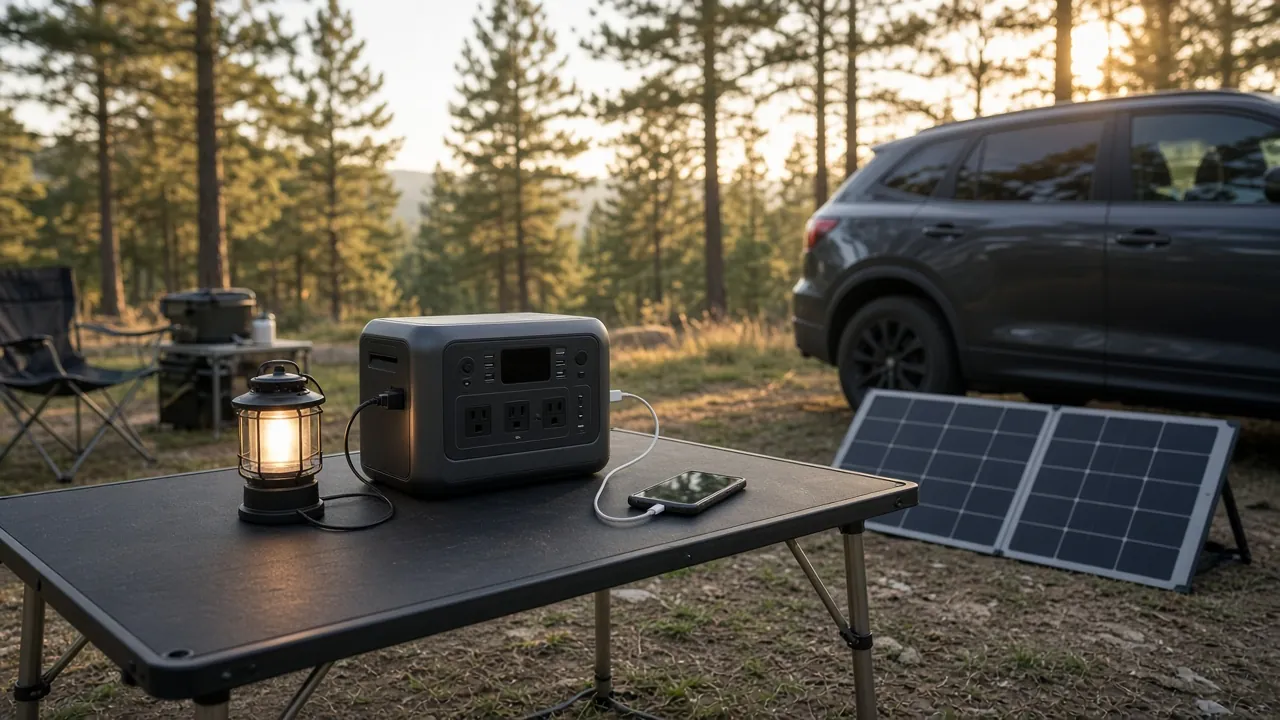
A portable power station is the single piece of gear that turns a parked car into a comfortable camp. It runs a 12V fridge overnight, charges phones and laptops, powers a fan or a heated blanket, and does it silently, with no fumes and no idling engine. But the spec sheets are crowded with numbers that are easy to misread. This roundup compares three popular roughly-1kWh models using the specifications their manufacturers publish, and explains which numbers actually matter when you sleep in a vehicle.
How we put this together: we did not test these units ourselves. This is a research roundup built from official product pages and user manuals (linked in our sources), plus basic electrical math. Prices change constantly, so treat any price here as a snapshot and check the current listing before you buy.
Quick picks
- Best all-rounder: EcoFlow DELTA 2 — 1024Wh LiFePO4, 1800W AC, expandable to about 3kWh. EcoFlow DELTA 2 on EcoFlow US
- Fastest to recharge: Anker SOLIX C1000 — 1056Wh, 1800W AC, 0–100% in a claimed 58 minutes on wall power, 600W solar input. Anker SOLIX C1000 on Anker SOLIX US
- Lightest of the three: Jackery Explorer 1000 v2 — 1070Wh (US model), 1500W AC, about 23.8 lb. Jackery Explorer 1000 v2 on Jackery US
Side-by-side specs
| Spec | EcoFlow DELTA 2 | Anker SOLIX C1000 | Jackery Explorer 1000 v2 |
|---|---|---|---|
| Capacity | 1024Wh | 1056Wh | 1070Wh (US listing) |
| Chemistry | LiFePO4 | LiFePO4 | LiFePO4 |
| Rated AC output | 1800W (2700W surge) | 1800W (SurgePad 2400W) | 1500W (3000W surge peak) |
| AC outlets | Varies by region; check listing | 6 of 11 total outlets | 3 |
| USB-C | 2 × 100W | 1 × 100W, 1 × 30W | 1 × 100W, 1 × 30W |
| 12V car socket | 126W max | 120W | 12V/10A |
| Max AC charging | 1200W | 1300W (UltraFast) | about 1.58 h full charge (AC) |
| Max solar input | 500W | 600W | 400W |
| Car charging | 12/24V, 8A | 120W car socket output listed; car charging input not captured | about 12 h with 12V adapter |
| Cycle rating | 3000 cycles to 80%+ | 3000 cycles | 4000 cycles to 70%+ |
| Weight | 27 lb / 12 kg | 28.44 lb / 12.9 kg | about 23.8 lb / 10.8 kg |
| Dimensions | 15.7 × 8.3 × 11 in | 14.8 × 8.07 × 10.5 in | 12.87 × 8.82 × 9.72 in |
| Price | Check current price (prices change often; checked Nov 4, 2026) | Check current price (prices change often; checked Nov 4, 2026) | Check current price (prices change often; checked Nov 4, 2026) |
| Expandable | Yes, to 2048Wh or 3040Wh | Yes, to 2112Wh | Not listed on the spec page we used |
| Warranty | 5 years | 5 years | 3+2 years |
Specs from each manufacturer's official product page or user guide as of November 2026. Regional versions differ (for example, Jackery's EU listing shows a 1024Wh version), so confirm the exact model on the listing you buy.
What actually matters for car camping
1. Watt-hours decide how long you last
Capacity, in watt-hours (Wh), is the size of the fuel tank. All three of these sit right around 1kWh, which is a sweet spot for weekend car camping: big enough to run a compressor fridge for a day or more, small enough to lift into a hatchback. A quick way to estimate runtime is to divide usable capacity by the average draw of what you plug in. Inverters and conversion losses eat some energy, so a conservative rule of thumb is to assume you get roughly 80–90% of the rated number.
For example, Dometic publishes an average draw of 1.03 amp-hours per hour for its CFX3 45 fridge at 12V in a hot 32°C (90°F) room with the inside set to 4°C. That is about 12.4W on average, or roughly 300Wh per day. On a ~1kWh station, that fridge alone would plausibly run around two and a half to three days in hot weather, before you add phones, lights, or a fan. Your real numbers will vary with heat, set point, and how often you open the lid.
2. Use the 12V socket instead of AC whenever you can
Most 12V camping fridges, fans, and many heated blankets run natively on 12V DC. Plugging them into the station's car socket skips the inverter, which wastes energy converting DC to AC. If you plug the fridge's AC adapter into an AC outlet, you lose energy twice: once in the station's inverter and again in the fridge's power brick. The DELTA 2 lists a 126W car socket and the Anker C1000 lists 120W; the Jackery lists 12V/10A. All three are plenty for a single fridge.
3. Recharging on the road
Car campers usually recharge in three ways: wall power before the trip, solar at camp, and the vehicle's 12V socket while driving. Wall-charge speed is where the Anker stands out, with a claimed 58-minute full charge using its UltraFast mode (check Anker's guide for how and when to use it). The DELTA 2 accepts up to 1200W on AC. The Jackery lists about 1.58 hours on AC.
Solar input caps how much sun you can harvest. The C1000 accepts up to 600W, the DELTA 2 500W, and the Jackery 400W. In practice, most car campers carry one or two 100–200W folding panels, so all three have headroom. Charging from a car's 12V socket is slow on any station, roughly 100W or so; Jackery lists about 12 hours for a full charge with its car adapter. Think of it as topping up, not refilling.
4. Weight and footprint
You will lift this thing in and out of the car more than you expect. The Jackery is the lightest at about 23.8 lb, the DELTA 2 is 27 lb, and the Anker is 28.44 lb. The Jackery lists 12.87 × 8.82 × 9.72 in, versus 14.8 × 8.07 × 10.5 in for the Anker and 15.7 × 8.3 × 11 in for the DELTA 2, so on paper it is both the lightest and the smallest of the three. If you drive a small hatchback or sleep in the back of a sedan, a few pounds and a couple of inches really matter.
5. Battery chemistry and lifespan
All three use LiFePO4 (lithium iron phosphate) cells, which are rated for thousands of cycles and are generally considered more thermally stable than older NMC cells. EcoFlow and Anker both list 3000 cycles; EcoFlow specifies "to 80+% capacity." Jackery lists 4000 cycles to 70%+ capacity. Because the end-of-life thresholds differ, those numbers are not a perfect apples-to-apples comparison, but any of them should last many years of weekend trips.
6. Temperature limits
Lithium batteries do not like charging below freezing. Anker lists charging at 32–104°F and discharging down to −4°F. Check Jackery's manual for its limits. If you winter camp, keep the station inside the cabin with you, not in a frozen trunk, and avoid solar charging it while it is below freezing.
Model by model
EcoFlow DELTA 2
The DELTA 2 is the "do-everything" pick in this group. It pairs a 1024Wh LiFePO4 battery with 1800W of AC output (2700W surge) and an X-Boost mode that EcoFlow rates at up to 2200W on its US page (2400W on its EU page). Its biggest advantage for long trips is expansion: EcoFlow says you can add a DELTA 2 Extra Battery to reach 2048Wh or a DELTA Max Extra Battery to reach 3040Wh. Two 100W USB-C ports are a nice bonus for laptop users. The trade-off is size: it measures 15.7 × 8.3 × 11 inches and weighs 27 lb.
Good fit if: you want one station that can grow with you, or you plan to run a fridge for longer trips with solar top-ups. Check current price: EcoFlow DELTA 2 on EcoFlow US
Anker SOLIX C1000
The C1000 leans on speed. Anker claims a full recharge in 58 minutes from the wall, and its 600W solar input is the highest here. It has six AC outlets and 11 outlets in total, 1800W of rated AC output, and what Anker calls SurgePad output up to 2400W. It is expandable to 2112Wh with Anker's matching expansion battery. It is also the heaviest of the three at 28.44 lb.
Good fit if: you often leave on short notice and need to fill the battery fast, or you want to rely heavily on solar. Check current price: Anker SOLIX C1000 on Anker SOLIX US
Jackery Explorer 1000 v2
Jackery's v2 is the compact option. The US listing shows 1070Wh in a body of about 23.8 lb, with 1500W rated AC output and a 3000W surge peak. It has fewer AC outlets (three) and lower solar input (400W) than the others, but for most car-camping loads (fridge, phone, laptop, fan) that is rarely a limitation. Note that at the time of writing, Jackery's US product page showed the unit as sold out, so availability may vary.
Good fit if: you have a smaller car, carry the station often, or value the lightest package. Check current price: Jackery Explorer 1000 v2 on Jackery US
Sizing worksheet: how big do you need?
Add up your expected daily energy use. Here is a sample night for one or two people, using typical device ratings (check your own devices' labels):
- 12V compressor fridge, hot weather: about 300Wh/day (based on Dometic's published CFX3 45 figure)
- Two phones, one full charge each: about 30Wh
- Laptop, one charge: about 60Wh
- Small 12V fan, 8 hours at 10W: about 80Wh
- LED string lights, 4 hours at 5W: about 20Wh
That is roughly 490Wh per day. With a ~1kWh station and real-world losses, you would have roughly a day and a half to two days of power without recharging. Solar extends that, but how much depends on weather, panel angle, and season. If you add an electric blanket or a cooking appliance, the math changes fast: a 1000W kettle or induction burner can use a large share of the battery in under an hour.
Safety and setup tips
- Keep the station ventilated; do not bury it under sleeping bags while it is charging or under heavy load.
- Secure it so it cannot slide or become a projectile while driving.
- Run 12V devices from the 12V socket and turn the AC inverter off when you are not using it, since an idle inverter still draws power.
- Read the manufacturer's manual for temperature limits, especially for cold-weather charging.
- Never run a fuel-burning heater or generator inside a closed vehicle. A battery-powered setup is the safe alternative.
Bottom line
All three stations land in the same ~1kWh class and would handle a typical car-camping weekend. On paper, the EcoFlow DELTA 2 is the most flexible thanks to its expansion options, the Anker SOLIX C1000 is the fastest to recharge and the best at harvesting solar, and the Jackery Explorer 1000 v2 is the lightest and most compact. Choose based on whether your biggest constraint is trip length, recharge time, or space in your car, and always confirm the current price and the exact regional model before buying.